
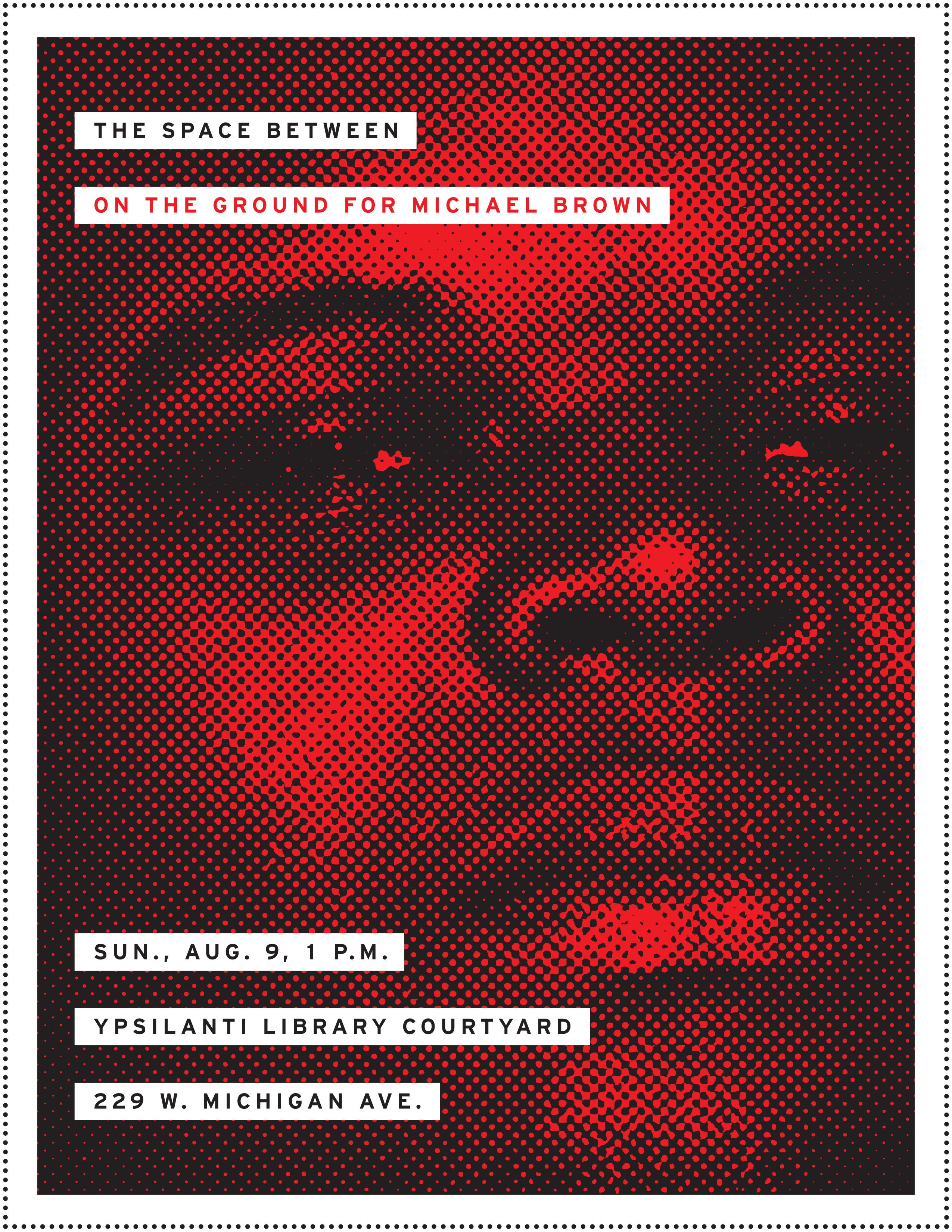
The Space Between

Cape Town to Ypsi

From Peter in South Africa
Buenos Aires to Ypsi

Protect Black Lives
On the Ground for Michael Brown
“Reasonable”
Liberals, especially white liberals, basically think things are pretty much fine as they are. Certainly things could be improved, but that kinda just happens on its own—society makes “progress,” it gets better, and it does so gradually, through “reasonable” dialogue and debate. That’s the extent of politics for liberals: “reasonable” speech. Even protest, for liberals, ends up being just another form of “reasonable” speech. A message is sent, an issue is framed, a proposal is made, a voice (or so the theory goes) is heard. There’s no room for direct action—an action that doesn’t depend on a request or a demand, that doesn’t place its hopes and dreams in the hands of another—in this model of politics. For liberals, any politics beyond the boundaries of “reasonable” speech is more or less a form of violence. Believing that politics is equivalent to “reasonable” speech also means participating in the long history of white supremacy, since historically the voices of Black resistance and insurrection, from the slave uprisings to the civil rights movement and urban rebellions of the 1960s to the Ferguson insurrection, have always been deemed “unreasonable.” It’s the “unreasonable” that gives us hope for an antiracist future.
Black Lives Matter: The Social Hobby
Anthony Morgan
This letter is from a disheartened, stressed, calloused human who can no longer bear the weight of a dominant culture that unknowingly and subconsciously subdues me—even the “good white folks.” I have seen at first hand how many of you have taken our plight and transformed it into a “to-do” list for your consciences. If I am one of your “black friends,” consider that the case no longer. The same goes for apathetic, non-action-oriented, scary-ass blacks!
THIS IS NOT A HOBBY,
YOU WILL GET NO PROPS
NO HIGH FIVES
NO LETTERS OF RECOMMENDATION
NO MEDALS …
only real strife.
“I knew that they shot at moving cars . . .”
Shortly before you were born, I was pulled over by the PG County police, the same police that all the D.C. poets had warned me of. They approached on both sides of the car, shining their flashlights through the windows. They took my identification and returned to the squad car. I sat there in terror. By then I had added to the warnings of my teachers what I’d learned about PG County through reporting and reading the papers. And so I knew that the PG County police had killed Elmer Clay Newman, then claimed he’d rammed his own head into the wall of a jail cell. And I knew that they’d shot Gary Hopkins and said he’d gone for an officer’s gun. And I knew they had beaten Freddie McCollum half-blind and blamed it all on a collapsing floor. And I had read reports of these officers choking mechanics, shooting construction workers, slamming suspects through the glass doors of shopping malls. And I knew that they did this with great regularity, as though moved by some unseen cosmic clock. I knew that they shot at moving cars, shot at the unarmed, shot through the backs of men and claimed that it had been they who’d been under fire. These shooters were investigated, exonerated, and promptly returned to the streets, where, so emboldened, they shot again. At that point in American history, no police department fired its guns more than that of Prince George’s County. The FBI opened multiple investigations—sometimes in the same week. The police chief was rewarded with a raise. I replayed all of this sitting there in my car, in their clutches. Better to have been shot in Baltimore, where there was the justice of the streets and someone might call the killer to account. But these officers had my body, could do with that body whatever they pleased, and should I live to explain what they had done with it, this complaint would mean nothing. The officer returned. He handed back my license. He gave no explanation for the stop.
—Ta-Nehisi Coates, Between the World and Me
ACLU of Michigan Supports Release of Faith Leader, Activist, in Election Fraud Case
Constitutional rights violations alleged in case of Rev. Edward Pinkney of Benton Harbor
GRAND RAPIDS—The trial of Rev. Edward Pinkney, 66, of Benton Harbor violated his constitutional rights according to a motion filed with the Michigan Court of Appeals. Supporters of Pinkney—including ACLU of Michigan who filed an amicus curiae brief backing the motion—are calling for his immediate release on bond pending appeal.
 Radical Washtenaw